Buy-side data strategy and content sourcing teams have long struggled with the monotony of the messy middle of data sourcing. When a PM names a thesis — LLM token spend by public companies, municipal fixed income, U.S. import flows — the process of having an analyst test their merit by disappearing into vendor lists, conference agendas, LinkedIn, and eventually producing a spreadsheet of maybes is costly. Add to that the sample chase: emails, follow-ups, calls, and internal coaching, just to see whether a vendor will send anything usable, most are looking at a multi-week or month process. In a good quarter, this leads to legal review, back-testing, schema mapping, and a contract conversation. More often, it ends as research that never clears the trial stage.
Brickroad, a frontier AI lab specializing in agentic infrastructure for data provisioning, thinks it can compress that middle stretch. The company recently released its Agent Catalogs and Agent Outboxes for its Information Frontier Agent (IFA), as well as an API designed to connect the workflow to existing CRMs, warehouses, and internal tooling. Co-founder and CEO, Freeman Lewin, described the latest release as a step toward becoming a data router for what he calls the “information frontier” — sources that might matter to a desk but are expensive to find, verify, and contract through brokers and marketplaces alone.
The framing is laid out in a thesis paper Brickroad published alongside the product push. Their argument is structural: data markets still behave like n×m bilateral wiring problems, where every source negotiates separately with every buyer and transaction costs — search, legal, integration — dominate small deals. A “multiplexer” layer, in the company’s telling, would let sources and endpoints connect once each, pushing integration count toward n+m and letting price track data utility rather than negotiating leverage. The IFA, in that architecture, is the discovery and qualification layer upstream of routing.
Where the market stops clearing
Brickroad’s latest paper uses an astronomy analogy — distant galaxies cost engineering and coordination per photon — to describe an economic boundary in information markets. Commodity datasets compress toward marginal cost; what retains margin is data that is costly to obtain, verify, integrate, or replicate. High fixed transaction costs, the paper argues, create a “viability frontier” where only large, marketed datasets routinely clear procurement. Niche corpora — a port consortium’s vessel logs, a hospital network’s imaging archive — may have real task utility but rarely survive a sourcing process built for headline vendors.
Whether Brickroad’s stack actually moves that frontier is untested at scale. The company cites industry procurement cycles of three to six months from discovery to production, with legal review alone running four to eight weeks — figures consistent with how buyside teams describe alt-data onboarding, though not independently benchmarked in the paper. Brickroad’s own IFA materials claim its discovery tooling can process between 500-1,000 sources in a single 20-minute run in order to discover and predict companies which may be producing data as exhaust from their operations and be willing to license the same.
What the IFA actually returns
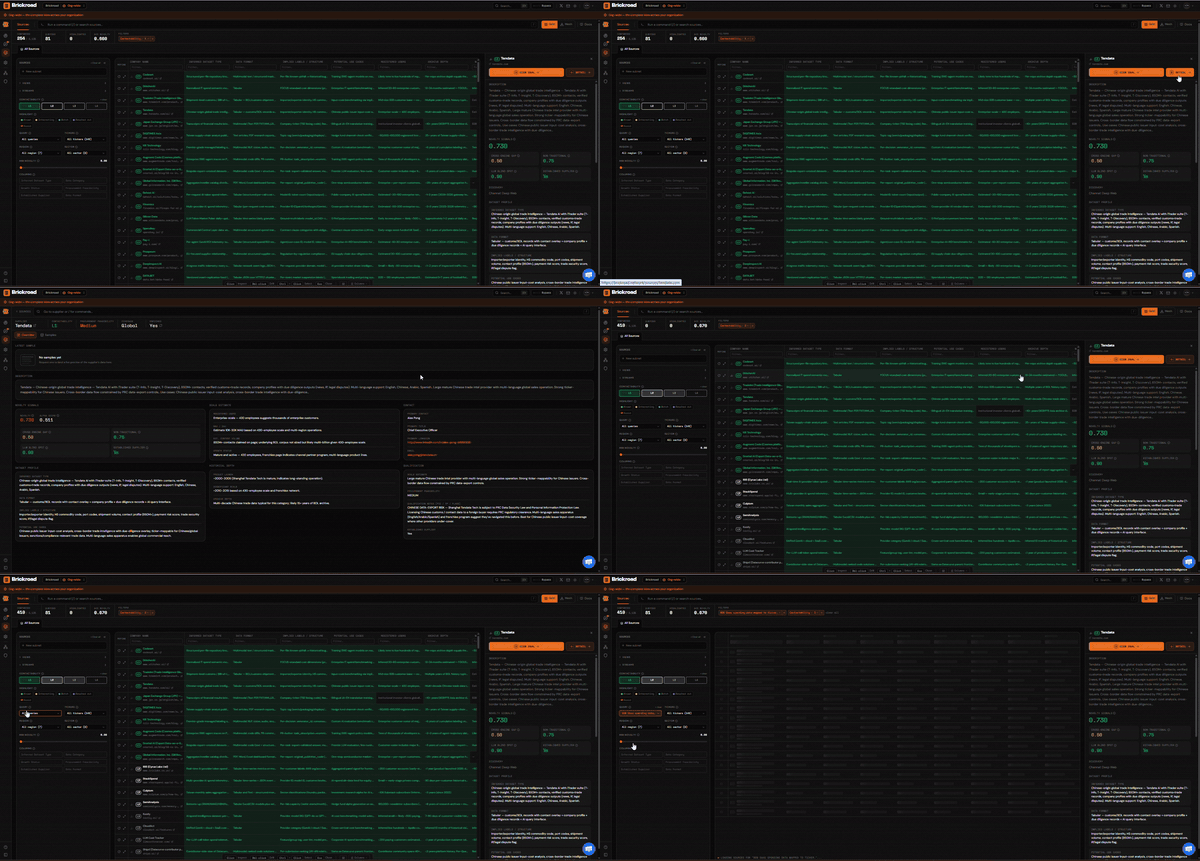
The Information Frontier Agent is Brickroad’s discovery product: an analyst names a vertical or thesis, and the system returns a table of candidate suppliers with metadata attached. In demos reviewed for this piece, a query for a “low latency AI token spend tracker” produced a supplier grid listing hundreds of scored rows, with aggregate stats showing thousands of sources parsed and a high verify rate displayed in the UI. Early users report runs on the order of 30 minutes that would take an analyst days of manual list-building — though throughput depends on query breadth.
Brickroad positions the IFA against data marketplaces such as Neudata, Eagle Alpha, and Datarade, and against general LLM search — categories that, by the company’s account, excel at cataloged, on-market data but miss pre-product suppliers and off-list alternatives. That competitive claim is plausible for teams hunting net-new vendors; it is also the kind of claim sourcing heads will want to pressure-test on their own mandates before reassigning analyst time.
Catalogs as shared desk state
Discovery output decays quickly without a system of record. Agent Catalogs are Brickroad’s attempt to turn IFA results into persistent inventory: filterable grids that desks can slice by contactability tier (L1–L4), outreach status, query, region, sector, and minimum novelty. Column sets expose the same metadata model the agent generates — growth stage, procurement feasibility, data format — in a layout closer to a working spreadsheet than a vendor PDF.
Standing queries can rerun on a schedule and diff against prior results; watchlists can be uploaded to highlight catalog gaps rather than rediscovering incumbents. Team plans add shared history and pod-level segmentation — features that matter because sourcing quality in most shops is a small-group sport, not a solo analyst task. None of this replaces a desk’s internal CRM or data catalog if one already exists; it is an overlay for the IFA-specific workflow.
Outboxes and the approval gate
Finding a vendor and acquiring a sample remain different problems. Agent Outboxes handle the second: when an analyst requests a sample, Brickroad’s access agent drafts outreach from a company-controlled inbox, with replies routed back into the customer’s dashboard. The intent, according to Brickroad, is to keep a desk’s thesis from broadcasting to the market while still automating the first-touch email.
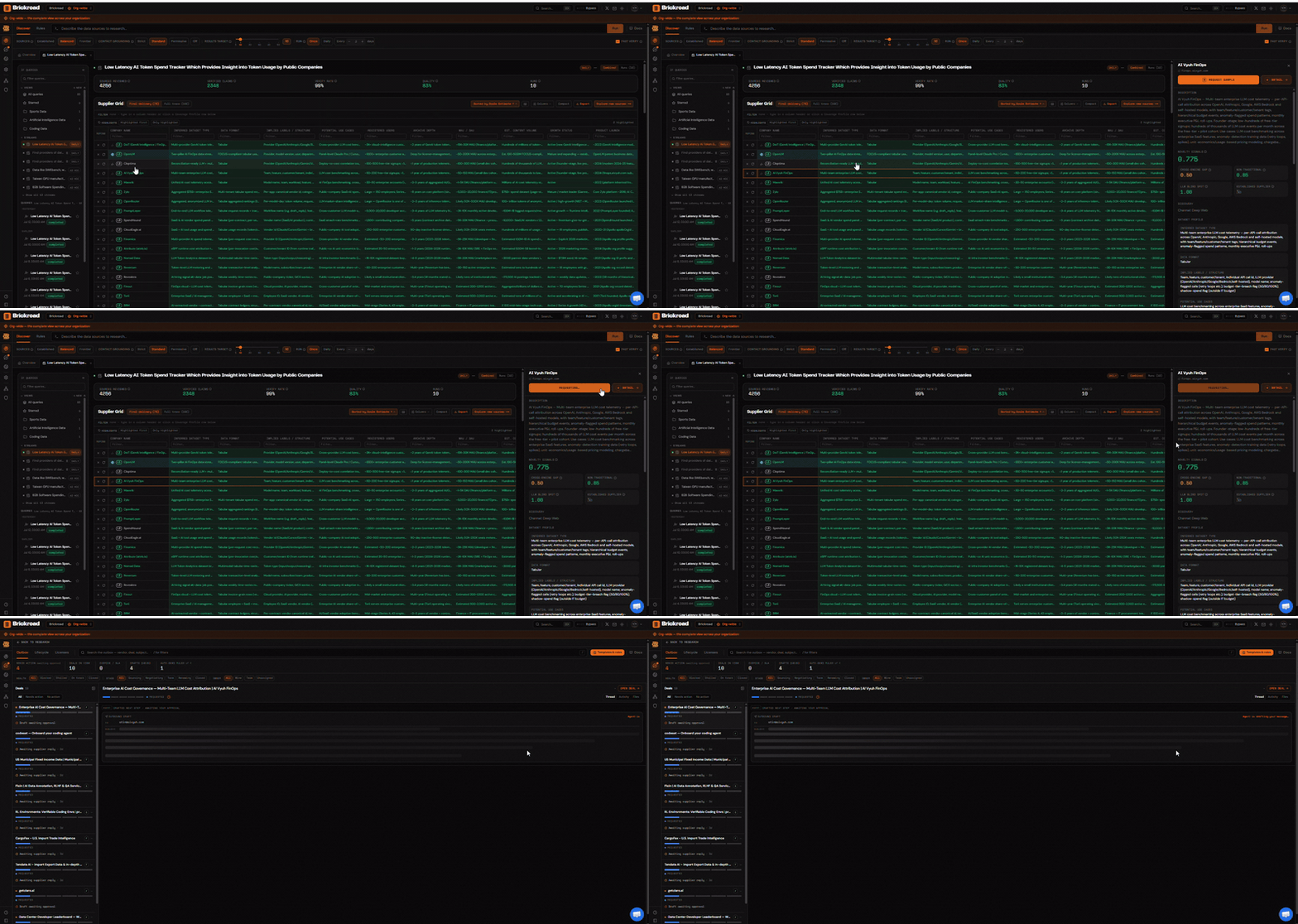
The workflow is explicitly human-gated. For a live deal — in demos, an enterprise LLM cost-attribution vendor — the agent produces a technical sample request covering schema, update frequency, delivery format, and indicative pricing; the analyst can edit, reject, or approve before anything sends. Brickroad surfaces desk-level time-saved counters in the UI; those numbers reflect the company’s internal modeling, not third-party measurement.
The design reflects a bet about regulated buyers: full autonomy would fail compliance review; pure manual outreach preserves the email cycles Brickroad says it is trying to shorten. Whether suppliers treat Brickroad-originated mail as credible buyer interest — rather than filtered spam — is an open operational question. Several buyside sourcing leads said vendor response rates to third-party sample requests remain the metric they would watch first.
Discovery at the Frontier
The Company also released it’s first API, which exposes a lead-card schema and integration paths with various webhooks, Slack, Salesforce, Snowflake, Databricks, on-site deployment — so programmatic clients can trigger discovery, ingest catalog rows, and open outbox workflows without rebuilding the broker-email state machine. BYO-keys support routes model inference through a customer’s own cloud billing.
Brickroad’s near-term buyer is the institutional data desk already paying for alt-data workflows: multi-strategy funds, asset managers, and research shops with global mandates – Brickroad has search capability across both Western and select Asian markets, including China, Japan, Korea, and Indonesia.
The release is a concrete test of a recurring alt-data complaint: the market has plenty of data, and not enough cheap ways to find out which data matters before the lawyers get involved. Brickroad is not launching another vendor directory. It is shipping a workflow — catalog, outbox, API — and asking desks to decide whether agents can do the boring parts without breaking the parts that still require a human signature.