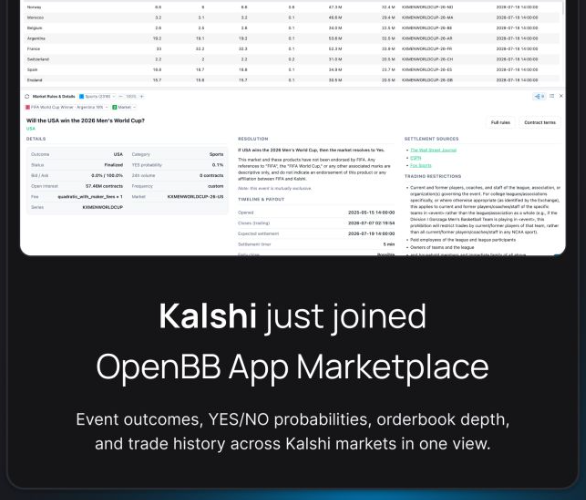
OpenBB, the open-source financial research platform often described as a challenger to the Bloomberg Terminal, has added Kalshi to its App Marketplace — the first prediction-markets app to appear in the catalog since the marketplace launched in May.
The announcement, made on LinkedIn today, was characteristically brief: “Welcome, Kalshi! First predictions market app on OpenBB App Marketplace.” But behind the one-line welcome sits a meaningful data point in a trend that has been accelerating all year: prediction market prices are migrating from betting apps and crypto dashboards into the professional workflows where investment research actually happens.
From event discovery to raw orderbook data
The app is structured as a drill-down. Users start with a readable directory of Kalshi’s events — the umbrella questions the exchange lists, from Federal Reserve decisions to election outcomes to economic data prints. Clicking an event surfaces all of its associated markets, the individual YES/NO contracts that trade against each outcome. Clicking into a single market opens the full picture: the live YES/NO probability implied by the contract price, orderbook depth on both sides, a stream of executed trades, and historical data available as both a chart and raw output.
That last layer matters more than it might sound. A headline probability — “the market says 72%” — is what makes prediction markets quotable. But depth, trade flow, and price history are what make them analyzable. An analyst who can see that a probability moved on thin volume, or that the orderbook is lopsided ahead of a data release, is working with a fundamentally richer signal than someone reading a single number off a website.
Like other apps in OpenBB’s marketplace, the Kalshi app lives inside OpenBB Workspace, where it sits alongside whatever else a user has connected — SEC filings, portfolio analytics, interest rate curves, crypto market data — and is compatible with the platform’s AI copilot, meaning the data can be queried in natural language and folded into agent-driven workflows.
An app the company saw coming
The listing has a curious backstory. When OpenBB introduced its Workspace MCP tooling on May 26 — infrastructure that lets AI coding agents like Codex and Claude Code build applications inside the Workspace — its flagship demo was an agent constructing a “Kalshi Event Explorer” from scratch. Given a product requirements document and access to Kalshi’s public API, the agent produced a working app: ten widgets across four tabs covering event discovery, market inspection, orderbook data, and probability analysis, configuration files included.
Six weeks later, that same anatomy — event discovery, market inspection, orderbook, probability, history — describes the official marketplace app. Whether the demo seeded the listing or simply anticipated it, the sequence says something about how OpenBB expects its catalog to grow: the gap between “interesting public dataset” and “production app in the Workspace” has collapsed to roughly the length of a product spec.
The App Marketplace itself, launched May 12, is OpenBB’s answer to a distribution problem on both sides of the data trade. Analysts want to trial unfamiliar datasets without a procurement cycle; vendors want to reach buyers at the moment of analysis rather than through a sales funnel. Founder and CEO Didier Lopes framed the marketplace as sitting between “a static catalog you browse, then fill out a form and wait for a sales rep” and “a raw API you get access to, then build everything yourself.” The launch catalog skewed toward traditional and alternative data — fundamentals, fixed income, order flow, crypto. Kalshi opens an entirely new category.
The exchange that grew up fast
Kalshi arrives in the catalog at a remarkable moment in its own trajectory. Founded in 2018 by MIT classmates Tarek Mansour and Luana Lopes Lara, the company spent its early years securing something no competitor had: designation as a CFTC-regulated exchange, granted in November 2020. That regulatory status — federal oversight rather than offshore or crypto-native operation — is the foundation of its institutional appeal.
The growth since has been steep. Kalshi reported roughly $260 million in fee revenue in 2025, up from $24 million the year before, and claimed an annualized trading volume of $178 billion by April 2026 — a thirty-twofold increase year over year. Its valuation has tracked the volume: roughly $5 billion in early 2025, $22 billion after a $1 billion raise in May 2026, and, per a June report in the Financial Times, talks to raise again at approximately $40 billion. CEO Mansour has floated an IPO, though not before 2027.
The company is also fighting a multi-front legal war. Gaming regulators in more than twenty states contend that its sports contracts amount to unlicensed gambling; Kalshi and the CFTC argue that federal jurisdiction over event contracts preempts state gaming law. The Third Circuit sided with Kalshi’s preemption argument in April, other courts have gone the other way, and a Supreme Court showdown looks increasingly plausible. For an analyst consuming Kalshi’s data through OpenBB, the litigation is background noise — but it is a reminder that the asset class supplying these probabilities is still being defined in court.
The signal goes institutional
The OpenBB listing is best read as one entry in a rapidly lengthening list. In February, Tradeweb — the electronic trading giant with more than 3,000 institutional clients — announced a strategic partnership with Kalshi and has since launched a dedicated Kalshi pricing page, complete with the exchange’s American Power Index, a market-implied gauge of U.S. political risk. Interactive Brokers launched a unified prediction-markets interface in May, routing orders across Kalshi, CME, and ForecastEx. On the rival side of the ledger, Intercontinental Exchange committed $2 billion to Polymarket and now pipes its probability data into the ICE Consolidated Feed — the same infrastructure that delivers NYSE equity prices.
The thesis underneath all of it is the same: prediction markets have become a credible “third opinion” on macro outcomes, alongside sell-side consensus and economist surveys. The Australian forecasting firm Dysrupt Labs has estimated that prediction markets agree with traditional consensus about 95% of the time — and that the 5% of divergences are where the uncorrelated value lives. “Investors want to trade on real events, not proxies,” Andy Ross, Kalshi’s head of institutional, said of the Tradeweb integration — a line that doubles as the pitch for putting this data in front of every analyst who might act on it.
What distinguishes the OpenBB integration from the Tradeweb and ICE deals is the audience. Those are institutional data feeds, priced and delivered accordingly. OpenBB’s marketplace is available on the platform’s free tier, and the Kalshi app’s premise — browse, click, inspect, no procurement — extends the institutionalization of prediction market data downmarket to individual analysts, small funds, and researchers. It is a data-and-analytics integration, not an execution venue; nobody is placing trades from the Workspace. But for the growing class of investors who treat event probabilities as an input rather than a wager, that is precisely the point.
Prediction markets spent two decades as a curiosity, a few years as a controversy, and the past eighteen months becoming infrastructure. With Kalshi’s arrival on OpenBB, the odds now sit one click away from the filings, the curves, and the fundamentals — exactly where the people pricing the future have always done their work.